Nontraditional Learning
Children thrive in both our indoor and outdoor classrooms where curiosity about the world drives them to learn. We provide professional guidance, the prepared environment, and scientifically developed materials for children to live
up to their full potential.
Learning Happens through purposeful activity
Children work with specially designed learning materials, manipulating and investigating them to master the lessons they embody.
abstract ideas in concrete form
Children use real objects to translate abstract ideas into concrete form. The example above, the binomial cube, physically represents a mathematical equation, which is (a + b)³ = (a + b) (a + b) (a + b) = a³ + 3a²b + 3ab² + b³.
OPPORTUNITIES FOR Outdoor learning
We are lucky to have a safe and secure 13-acre campus which provides students with many opportunities to work and play outside. Each classroom also has an exterior door, so students have access to the prepared outdoor learning environment daily.
Committed professionals
Our committed and credentialed professionals foster a child's cognitive, physical, and social/emotional well-being, leading children to become enthusiastic, intrinsically motivated learners.
TMA at a Glance
Our Global Community Celebrating DEIB
Maria Montessori’s educational philosophy, emphasizing equality, inclusivity, and the empowerment of marginalized communities, was rooted in the belief that every child, regardless of their background, deserves access to quality education. With students and staff members representing more than 20 countries, we consider TMA to be a small-scale global community.
Highly Committed Teachers
29% of our teachers are in their second decade of service at TMA, while the average tenure of lead classroom teachers at TMA is 9 years. The average tenure of all teaching staff at TMA is 7.5 years.
Accreditation
“The child who has never learned to work by himself, to set goals for his own acts, or to be the master of his own force of will is recognizable in the adult who lets others guide his will and feels a constant need for approval of others.”
- Maria Montessori, Education and Peace
A Walk through Early Childhood
What does a typical day look like?
Indoor Classroom
Students engage in academic and other purposeful work using hands-on, scientifically developed materials.
Outdoor Classroom
Students engage in academic work, gardening, animal care, gross motor development, and imaginative play.
TMA Programs
Lower and Upper School
Developmental stages of learning are at the core of a Montessori education. Our Lower School is designed for children between 6 weeks and 6 years of age, and our Upper School is for children between 6 and 12 years old. Within each school, there are programs designed to enhance learning for each specific developmental stage.
Process vs. Product Based Learning
Infant – 6 weeks to 18 months
Toddler – 18 months to 3 years
Early Childhood – 3 to 6 years
Lower Elementary – 6-9 years
Upper Elementary – 9-12 years
A Peek Inside
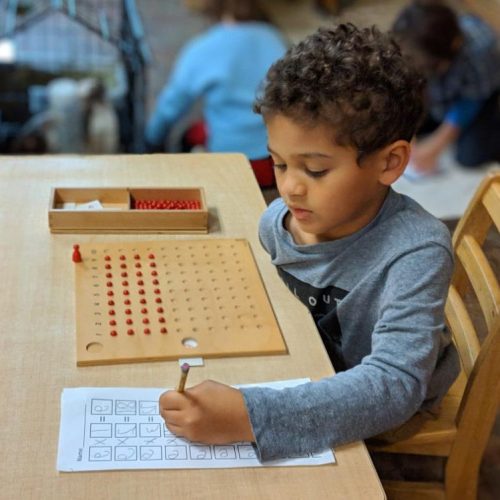
Early Childhood Multiplication Board
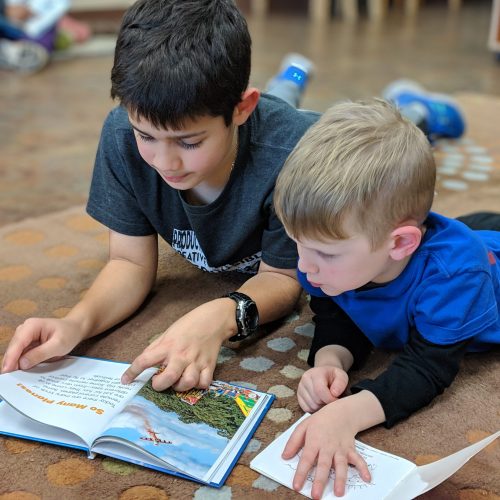
Elem & Early Childhood Reading Buddies
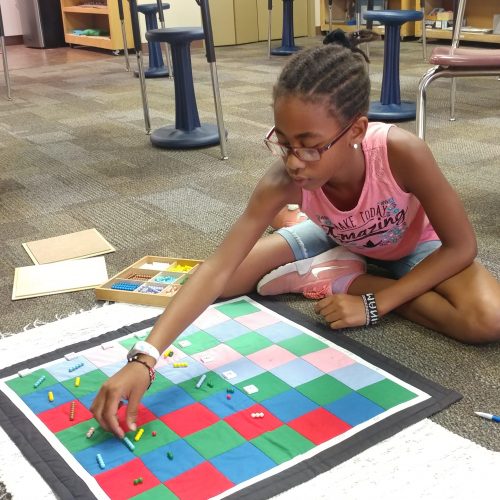
Upper Elementary Decimal Multiplication

Early Childhood Sandpaper Letters

Infant Peer Interactions

Early Childhood Preparing Snack

Lower Elementary Botany
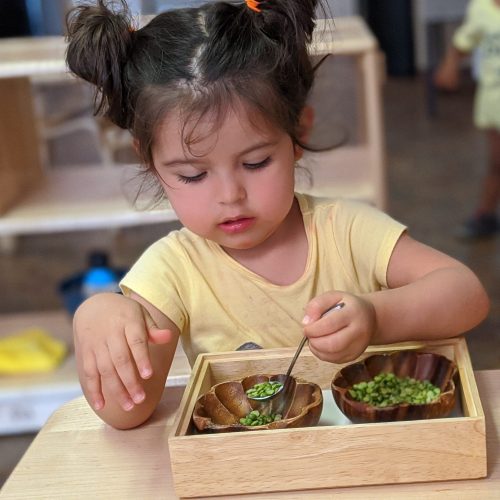
Toddler Transferring
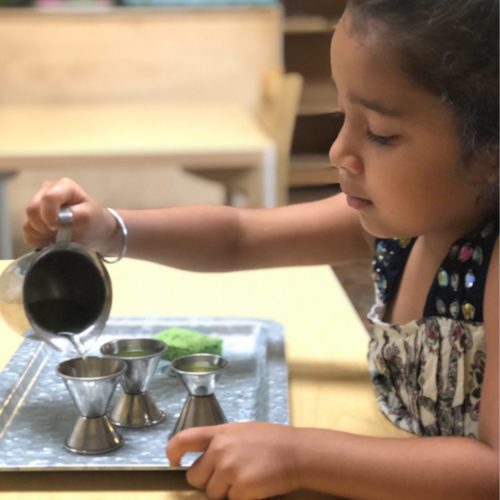
Early Childhood Wet Pouring
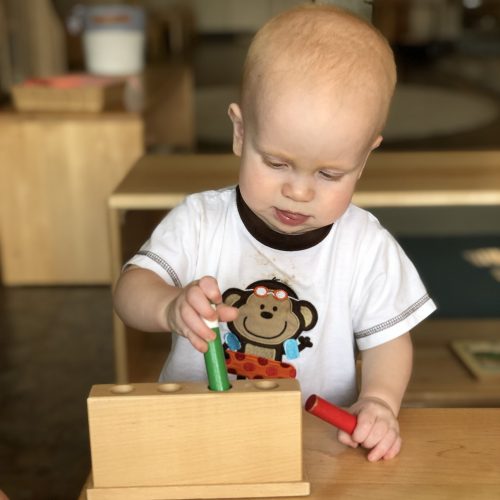
Infant Imbucare

Early Childhood Easel Painting
FAQs
Usually, our operational hours are from 7:00 am to 6:00 pm. Due to the new restrictions for the 2020-21 school year, we are only able to provide care between the hours of 7:30 am and 4:30 pm.
Infant, Toddler, and Early Childhood
The school day is from 8:30 am to 3:30 pm, with Before Care from 7:30-8:30 am and Extended Day from 3:30-4:30 pm.
Elementary
The school day is from 8:00 am to 3:30 pm, with Extended Day from 3:30-4:30 pm.
Under normal circumstances, the new school year starts with our summer term, the day after Memorial Day, near the end of May or beginning of June depending on the calendar. This is the beginning of our 12-month option. Our fall term and 10-month option begins in August and closely follows the Arlington ISD school calendar, though, we usually begin a week before AISD.
We are open for the 2020-2021 school year! The first day of school was August 10 and the last day will be May 28. We have added an additional 2 weeks to the school year to try to offset possible future stay-at-home orders.
Our ratios vary by program and have changed for the 2020-21 school year due to COVID-19:
-- Infant – 1:4 (2 teachers for 8 students)
-- Toddler – 1:7 (2 teachers for 14 students)
-- Early Childhood – 1:10 (2 teachers to 20 students)
-- Elementary – 1:10 (2 teacher to 20 students)
While these are the minimum ratios, we have an additional teacher available for each of the Infant, Toddler, and Early Childhood classrooms throughout the day. Elementary students also participate in Enrichment classes with Enrichment Specialist teachers.
All families provide their own healthy lunch options for their children.
Parents provide snacks and lunch for children enrolled in the Infant program.
A few times each year, families with students enrolled in the Toddler and Early Childhood programs will receive a list of groceries to purchase to bring for the classroom snack. As part of the Practical Life work in class, students will prepare snack each day.
Lower Elementary students will be assigned a day each month to bring the classroom snack. Upper Elementary students will bring snacks for themselves each day.
The nap schedule for infants is individualized and based on an infant’s age and need.
Toddlers and 2.5 to 3-year old Early Childhood students take a nap in the afternoon, after lunch.
Early Childhood students who are 4-years old are asked to rest for at least 30 minutes each day, with some still needing a full nap and others only resting their bodies for a short time.
Early Childhood students who are 5-years old do not nap and take part in special enrichment classes or work in the afternoon.
Parents of children with diagnosed allergies or asthma are required to provide the school with an individualized health care plan, signed by the child’s medical provider. A list of children with medically documented food allergies is posted in every classroom throughout the school, and a list of the classroom allergens is posted outside of each room.
TMA was established as a parent cooperative and, as such, requires parental involvement. Not only does community service help to build stronger bonds between community members, but it also provides excellent modeling for the volunteerism that we wish to instill in our students.
Parents pay a Community Service Fee of $300 each year, $150 for the fall term and $150 for the spring term. If one or more members of your family volunteer at TMA for 5 hours each semester or 10 hours for the year, you will be refunded the entirety of the Community Service Fee, or you may contribute it to the Scholarship Fund.
Several forms of communication are used to meet the needs of our community. These include email, texting, phone calls, Microsoft Teams, written documentation, parent/teacher conferences, a parent portal on our website, a closed Facebook group, and Bloomz, a photo/video sharing app so parents can catch glimpses of the work their children are completing.
We produce a weekly e-newsletter to keep parents informed about school-wide activities and events which is available via email, text, our closed Facebook group, the parent portal, and through Bloomz.
For infants, in additional to daily, in-person communication, teachers and parents complete a daily form so both parties know when diapers were changed, meals/snacks were eaten, and naps were taken.
Injuries will be promptly treated by a staff member and parents will be notified either by telephone or through a copy of a completed Accident/Incident Report form. Parents will receive a short report which documents how, when, and where and accident or incident occurred.
FAQs
Usually, our operational hours are from 7:00 am to 6:00 pm. Due to the new restrictions for the 2020-21 school year, we are only able to provide care between the hours of 7:30 am and 4:30 pm.
Infant, Toddler, and Early Childhood
The school day is from 8:30 am to 3:30 pm, with Before Care from 7:30-8:30 am and Extended Day from 3:30-4:30 pm.
Elementary
The school day is from 8:00 am to 3:30 pm, with Extended Day from 3:30-4:30 pm.
For the Lower School, the new school year starts the day after Memorial Day, near the end of May or beginning of June depending on the calendar. Our Upper School begins in August and closely follows the Arlington ISD school calendar, though, we usually begin a week before AISD.
Our ratios vary by program and have been lowered due to COVID-19:
-- Infant – 1:4 (2 teachers for 8 students)
-- Toddler – 1:7 (2 teachers for 14 students)
-- Early Childhood – 1:10 (2 teachers to 20 students)
-- Elementary – 1:10 (2 teacher to 20 students)
While these are the minimum ratios, we have an additional teacher available for each of the Infant, Toddler, and Early Childhood classrooms throughout the day. Elementary students also participate in Enrichment classes with Enrichment Specialist teachers.
All families provide their own healthy lunch options for their children.
Parents provide snacks and lunch for children enrolled in the Infant program.
A few times each year, families with students enrolled in the Toddler and Early Childhood programs will receive a list of groceries to purchase to bring for the classroom snack. As part of the Practical Life work in class, students will prepare snack each day.
Lower Elementary students will be assigned a day each month to bring the classroom snack. Upper Elementary students will bring snacks for themselves each day.
The nap schedule for infants is individualized and based on an infant’s age and need.
Toddlers and 2.5 to 3-year old Early Childhood students take a nap in the afternoon, after lunch.
Early Childhood students who are 4-years old are asked to rest for at least 30 minutes each day, with some still needing a full nap and others only resting their bodies for a short time.
Early Childhood students who are 5-years old do not nap and take part in special enrichment classes or work in the afternoon.
Parents of children with diagnosed allergies or asthma are required to provide the school with an individualized health care plan, signed by the child’s medical provider. A list of children with medically documented food allergies is posted in every classroom throughout the school, and a list of the classroom allergens is posted outside of each room.
TMA was established as a parent cooperative and, as such, requires parental involvement. Not only does community service help to build stronger bonds between community members, but it also provides excellent modeling for the volunteerism that we wish to instill in our students.
Parents pay a Community Service Fee of $300 each year, $150 for the fall term and $150 for the spring term. If one or more members of your family volunteer at TMA for 5 hours each semester or 10 hours for the year, you will be refunded the entirety of the Community Service Fee, or you may contribute it to the Scholarship Fund.
Several forms of communication are used to meet the needs of our community. These include email, texting, phone calls, Microsoft Teams, written documentation, parent/teacher conferences, a parent portal on our website, a closed Facebook group, and Bloomz, a photo/video sharing app so parents can catch glimpses of the work their children are completing.
We produce a weekly e-newsletter to keep parents informed about school-wide activities and events which is available via email, text, our closed Facebook group, the parent portal, and through Bloomz.
For infants, in additional to daily, in-person communication, teachers and parents complete a daily form so both parties know when diapers were changed, meals/snacks were eaten, and naps were taken.
Injuries will be promptly treated by a staff member and parents will be notified either by telephone or through a copy of a completed Accident/Incident Report form. Parents will receive a short report which documents how, when, and where and accident or incident occurred.
FAQs
We are open between 7:00 am and 6:00 pm, Monday through Friday. The school day is from 8:30 am to 3:30 pm, with Before Care from 7:00-8:30 am and Extended Day from 3:30-4:30 pm or Extended Day Plus from 3:30-6:00 pm.
Yes. Our enrollment contracts cover an entire school year. If you are admitted after the beginning of a school year, your tuition is pro-rated based on when you enroll. There is a 3-week trial for students enrolled in our Lower School.
For the Lower School, the new school year starts the day after Memorial Day, near the end of May or beginning of June depending on the calendar. Our Upper School begins in August and closely follows the Arlington ISD school calendar, though, we usually begin a week before AISD.
Our ratios vary by program:
-- Infant – 1:4 (2 teachers for 8 students)
-- Toddler – 1:8 (2 teachers for 16 students)
-- Early Childhood – 1:12 (2 teachers to 24 students)
-- Elementary – 1:18 (1 teacher for up to 18 students)
While these are the minimum ratios, we have an additional teacher available for each of the Infant, Toddler, and Early Childhood classrooms throughout the day. Elementary students also participate in Enrichment classes with Enrichment Specialist teachers.
All families provide their own healthy lunch options for their children.
Parents provide snacks and lunch for children enrolled in the Infant program.
A few times each year, families with students enrolled in the Toddler and Early Childhood programs will receive a list of groceries to purchase to bring for the classroom snack. As part of the Practical Life work in class, students will prepare snack each day.
Elementary students will bring snacks for themselves each day.
The nap schedule for infants is individualized and based on an infant’s age and need.
Toddlers and 2.5 to 3-year old Early Childhood students take a nap in the afternoon, after lunch.
Early Childhood students who are 4-years old are asked to rest for at least 30 minutes each day, with some still needing a full nap and others only resting their bodies for a short time.
Early Childhood students who are 5-years old are asked to rest for at least 30 minutes a day and take part in special enrichment classes or work in the afternoon.
Parents of children with diagnosed allergies or asthma are required to provide the school with an individualized health care plan, signed by the child’s medical provider. A list of children with medically documented food allergies is posted in every classroom throughout the school, and a list of the classroom allergens is posted outside of each room.
TMA was established as a parent cooperative and, as such, requires parental involvement. Not only does community service help to build stronger bonds between community members, but it also provides excellent modeling for the volunteerism that we wish to instill in our students.
Parents pay a Community Service Fee of $300 each year, $150 for the fall term and $150 for the spring term. If one or more members of your family volunteer at TMA for 5 hours each semester or 10 hours for the year, you will be refunded the entirety of the Community Service Fee, or you may contribute it to the Scholarship Fund.
Several forms of communication are used to meet the needs of our community. These include email, texting, phone calls, Microsoft Teams, written documentation, parent/teacher conferences, a parent portal on our website, a closed Facebook group, and Bloomz, a photo/video sharing app so parents can catch glimpses of the work their children are completing.
We produce a weekly e-newsletter to keep parents informed about school-wide activities and events which is available via email, text, our closed Facebook group, the parent portal, and through Bloomz.
For infants, in additional to daily, in-person communication, teachers and parents complete a daily form so both parties know when diapers were changed, meals/snacks were eaten, and naps were taken.
Injuries will be promptly treated by a staff member and parents will be notified either by telephone or through a copy of a completed Accident/Incident Report form. Parents will receive a short report which documents how, when, and where and accident or incident occurred.
FAQs
We are open between 7:00 am and 6:00 pm, Monday through Friday. The school day is from 8:30 am to 3:30 pm, with Before Care from 7:00-8:30 am and Extended Day from 3:30-4:30 pm or Extended Day Plus from 3:30-6:00 pm.
Yes. Our enrollment contracts cover an entire year, offering options for a traditional school year of 10 months or a year-round, 12-month option. If you are admitted after the beginning of a school year, your tuition is pro-rated based on when you enroll. There is a 3-week trial for students enrolled in our Lower School.
Each new school year begins in August and closely follows the Arlington ISD school calendar. We offer enrollment throughout the school year on a space-available basis, with tuition being pro-rated for those who start later in the year.
Our ratios vary by program:
-- Infant – 1:4 (2 teachers for 8 students)
-- Toddler – 1:8 (2 teachers for 16 students)
-- Early Childhood – 1:12 (2 teachers to 24 students)
-- Elementary – 1:18 (1 teacher for up to 18 students)
While these are the minimum ratios, we have an additional teacher available for each of the Infant, Toddler, and Early Childhood classrooms throughout the day. Elementary students also participate in Enrichment classes with Enrichment Specialist teachers.
All families provide their own healthy lunch options for their children.
Parents provide snacks and lunch for children enrolled in the Infant program.
A few times each year, families with students enrolled in the Toddler and Early Childhood programs will receive a list of groceries to purchase to bring for the classroom snack. As part of the Practical Life work in class, students will prepare snack each day.
Elementary students will bring snacks for themselves each day.
The nap schedule for infants is individualized and based on an infant’s age and need.
Toddlers and 3- and 4-year-old Early Childhood students take a nap in the afternoon, after lunch.
Early Childhood students who are 5-years-old take part in special enrichment classes and have another work cycle in the afternoon.
Parents of children with diagnosed allergies or asthma are required to provide the school with an individualized health care plan, signed by the child’s medical provider. A list of children with medically documented food allergies is posted in every classroom throughout the school, and a list of the classroom allergens is posted outside of each room.
TMA was established as a parent cooperative and, as such, requires parental involvement. Not only does community service help to build stronger bonds between community members, but it also provides excellent modeling for the volunteerism that we wish to instill in our students.
Parents pay a Community Service Fee of $300 each year, $150 for the fall term and $150 for the spring term. If one or more members of your family volunteer at TMA for 5 hours each semester or 10 hours for the year, you will be refunded the entirety of the Community Service Fee, or you may contribute it to the Scholarship Fund.
Several forms of communication are used to meet the needs of our community. These include email, texting, phone calls, written documentation, parent/teacher conferences, a parent portal on our website, a closed Facebook group, and Bloomz, a photo/video sharing app so parents can catch glimpses of the work their children are completing.
We produce a weekly e-newsletter to keep parents informed about school-wide activities and events which is available via email, text, our closed Facebook group, the parent portal, and through Bloomz.
For infants, in additional to daily, in-person communication, teachers record when diapers were changed, meals/snacks were eaten, and naps were taken in the Bloomz app.
Injuries will be promptly treated by a staff member and parents will be notified either by telephone or through a copy of a completed Accident/Incident Report form. Parents will receive a short report which documents how, when, and where and accident or incident occurred.
4 Easy Steps to Admission
Our admissions team will lead you through the entire process to answer your questions and provide all the information you need so your family can make an informed decision about whether TMA is the right choice for your child and your family. We understand that choosing the right school is an extremely important decision and we will be here to guide you through the decision-making process.
Schedule a Visit
Apply Online
Complete an online application and submit $300 application fee. The application fee is fully refundable until an enrollment contract is signed.
A 3-day classroom evaluation will be scheduled for students applying for a space in the Elementary program; a 3-week trial may instead be offered during the summer months when an evaluation is not possible.
Meet with the Head of School
During the 1½ hour meeting, “fit and match” between the family’s expectations for their child and TMA’s vision is explored and information about the classroom evaluation (if applicable) and a detailed tuition payment schedule will be discussed.
Complete Online Enrollment
Upon acceptance to TMA, the enrollment process begins with a contract being offered. The Application Fee becomes non-refundable after we receive your contract. Once we have received your online enrollment and first tuition payment, your enrollment is complete.
What do parents say about TMA?
We are happy with TMA, my child has been attending the school and he has learned so much. The school environment is clean and has so much for my son who loves to be in outdoors. Teachers and the administrators are helpful.
Great Schools
After touring over a dozen preschools, TMA came out on top for us. We love the focus on teaching important life skills and building character, not just behavior. The teachers interact with the students in a way that helps them to become independent and thoughtful little people.
Google Reviews
This is a GEM in the middle of the metroplex, with acres of nature surrounding the school. Kids are given a unique opportunity to experience and enjoy nature in a caring environment, while learning so much, both in and out of the classroom. Our child really likes it here.
Niche Reviews
TMA is a great school that helps students gain independence, learn concepts deeply, and become well-rounded citizens of the world. The teachers are dedicated, and the campus is beautiful and inviting. TMA is a great place to be!
Private School Review

Important Dates
Gallery of Student Work

You might see a simple dropper… we see powerful learning. 💧
This liquid transfer work helps toddlers develop fine motor strength, hand control, and focus—all essential for future skills like writing, feeding themselves, and everyday independence.
#PracticalLife #MontessoriInAction #FineMotorSkills #HandsOnLearning #EarlyChildhoodEducation #ToddlerLearning #Concentration #Independence #MontessoriLife #NontraditionalLearning #TheMontessoriAcademyOfArlington

✨ Building Big Ideas Through Small Hands-On Work ✨
This Early Childhood student is using Montessori 3-part cards to explore influential people who have helped shape our world, including figures like Mahatma Gandhi and Jane Addams. This work introduces children to the study of history, helping them understand that people in the past made choices, took action, and created change that still impacts our lives today.
As children match pictures with labels, they strengthen essential skills like vocabulary, reading readiness, concentration, and attention to detail. The hands-on nature of this work also fosters independence and confidence, as students self-correct and progress at their own pace.
At the same time, students are developing a deeper understanding of historical impact and human responsibility. They begin to see that history is not just something that happened long ago—it is shaped by individuals who demonstrate leadership, compassion, and care for others and the environment.
These experiences support empathy, character development, and a growing awareness of how they, too, can contribute meaningfully to the world around them. 🌎
#Montessori #EarlyChildhoodEducation #HandsOnLearning #LearningHistory #Changemakers #PeaceEducation #IndependentLearners #CuriousLearners #Nontraditional #PrivateEducation #TheMontessoriAcademyOfArlington

📐 Building Strong Mathematical Minds—One Bead at a Time
In our Lower Elementary classroom, students don’t just solve long division—they experience it.
Using the Golden Bead Material, this student is working through a long division problem in a hands-on, concrete way. Instead of memorizing steps, they are physically distributing thousands, hundreds, tens, and units into equal groups—truly seeing what division means.
✨ Why this work matters:
--Concrete to Abstract Understanding: Students first touch and move quantities before transitioning to paper-and-pencil algorithms, building deep comprehension rather than surface-level memorization.
--Confidence Through Mastery: By breaking down complex problems into manageable, visual steps, students gain independence and problem-solving confidence.
--Multi-Sensory Learning: Engaging the mind and the hands helps solidify mathematical concepts in a meaningful and lasting way.
--Error Control & Self-Correction: The material allows students to recognize and fix mistakes independently—an essential lifelong skill.
This is the beauty of Montessori math: children develop not only strong computational skills, but also a true understanding of why math works.
💛 Learning becomes visible. Thinking becomes tangible. Confidence becomes natural.
#MontessoriMath #HandsOnLearning #ElementaryEducation #IntrinsicMotivation #LoveOfLearning #NontraditionalLearning #TheMontessoriAcademyOfArlington

🌍✨ Learning About Our World—One Piece at a Time ✨🌍
In our Early Childhood classroom, a student is exploring the beauty of global diversity with our Montessori flag matching work. Each flag is divided into two wooden pieces, inviting children to observe, compare, and connect.
This simple yet powerful activity nurtures:
🧠 Cognitive development – strengthening memory, concentration, and pattern recognition
✋ Fine motor skills – refining hand-eye coordination and control
🌎 Cultural awareness – introducing children to countries around the world and fostering respect for diversity
🎯 Independence and confidence – allowing children to self-correct and learn at their own pace
Through hands-on materials like these, children build a deeper understanding of the world while developing essential foundational skills—joyfully and meaningfully. 💛
#HandsOnLearning #GlobalAwareness #IntrinsicMotivation #FineMotorSkills #LearningThroughPlay #MontessoriEducation #NonTraditionalLearning #TheMontessoriAcademyOfArlington

🌱🔬 Learning Comes Full Circle 🔬🌱
Our Upper Elementary students recently had the opportunity to take their Science Fair projects one step further—by becoming teachers! They proudly presented their experiments to our toddler community, sharing their discoveries with curiosity, patience, and enthusiasm.
This kind of cross-age learning is a powerful part of the Montessori experience. As the older students explain their work, they deepen their understanding, strengthen communication skills, and build confidence. Meanwhile, our youngest learners are inspired by real examples of inquiry, creativity, and problem-solving—planting the seeds for future exploration.
Moments like these highlight the beauty of a Montessori environment: a community where students learn with and from one another. 💛
#PeerLearning #LeadershipInAction #ScienceInMontessori #CuriosityDriven #LifelongLearners #NonTraditionalLearning #TheMontessoriAcademyOfArlington

Curiosity in action 🌿🔍
A closer look reveals a whole new world. In our Outdoor Classroom, this young Montessori student used a magnifying glass to carefully observe a leaf—making an exciting discovery along the way! These moments of exploration invite children to slow down, notice details, and engage deeply with the natural world.
Experiences like this support:
✨ Scientific observation and inquiry
✨ Concentration and patience
✨ A genuine connection to nature
✨ The joy of independent discovery
The second photo captures what was found—just a small glimpse into the meaningful, hands-on learning happening every day. 🐛🍃
#MontessoriMoments #OutdoorLearning #LearningThroughDiscovery #CuriousMinds #HandsOnLearning #PurposefulActivity #NontraditionalLearning #PrivateEducation #TheMontessoriAcademyofArlington
It is the policy of The Montessori Academy to maintain a school environment that is free from discrimination and to conduct its educational practices, admissions program, financial aid policies, hiring, and other school-administrative programs on the basis of an individual’s qualifications and abilities. The Montessori Academy does not discriminate on the basis of race, color, religion (unless it is required as a bona fide occupational qualification), sex, national origin, age, gender, sexual orientation, marital status, disability, genetic information, or any other characteristic protected by law.