Skip to content
TMA Logo TMA Logo, The Montessori Academy of Arlington, Private School Arlington TX
  • About TMA
    • Accreditation
    • Annual Events
    • Calendar
    • Connect
      • Contact Us
      • Meet our Staff
      • School Location
      • Careers
    • Family Handbook
    • Gallery of Student Work
    • Graduate Outcomes
    • Learning Spaces at TMA
    • Parenting Resources
    • Videos
    • Privacy Policy & SMS Terms of Service
  • TMA Programs
    • Lower School
      • Infant
      • Toddler
      • Early Childhood
    • Upper School
    • Extended Day
    • Summer at TMA
  • About Montessori
    • Alumni Thoughts
    • How is Montessori Different?
    • Montessori Resources
    • Non-Traditional Education
  • Admissions
    • Admissions Overview
    • FAQs
    • Schedule a Tour
    • Tuition and Fees
    • How to Apply
  • My TMA
    • Family Resources Site
    • FACTS Family Portal

© 2019

Schedule a Tour

Gallery of Student Work

See exactly how we prepare children for life, not just the next test. Children at TMA work with specially designed learning materials, manipulating and investigating them to master the lessons they embody. Children use real objects and actions to translate abstract ideas into concrete form. Learning happens through purposeful activity.

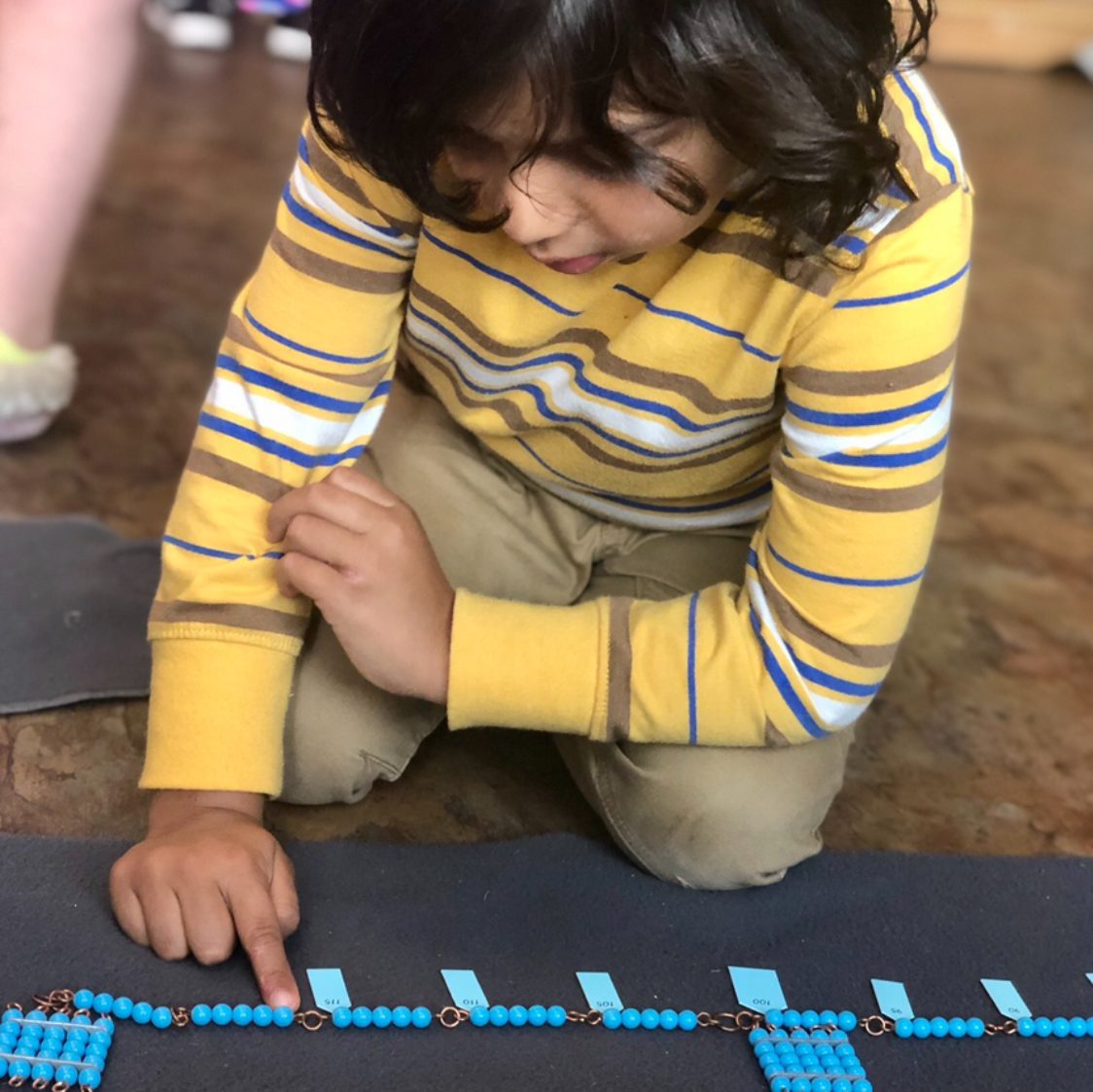
Early Childhood Bead Chain for Linear and Skip Counting, The Montessori Academy of Arlington, Private School Arlington TX
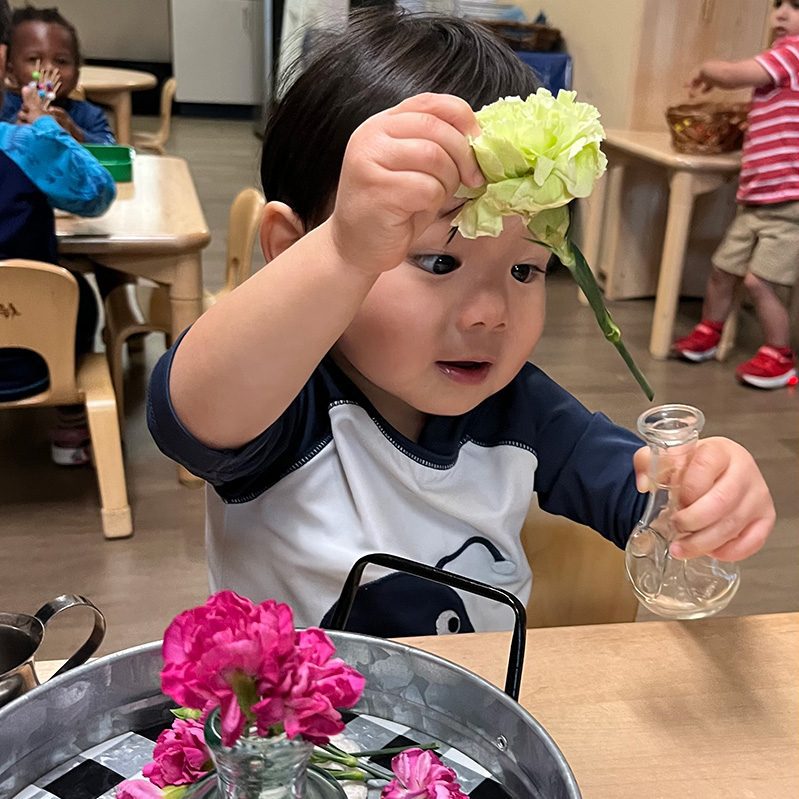
Toddler Flower Arranging
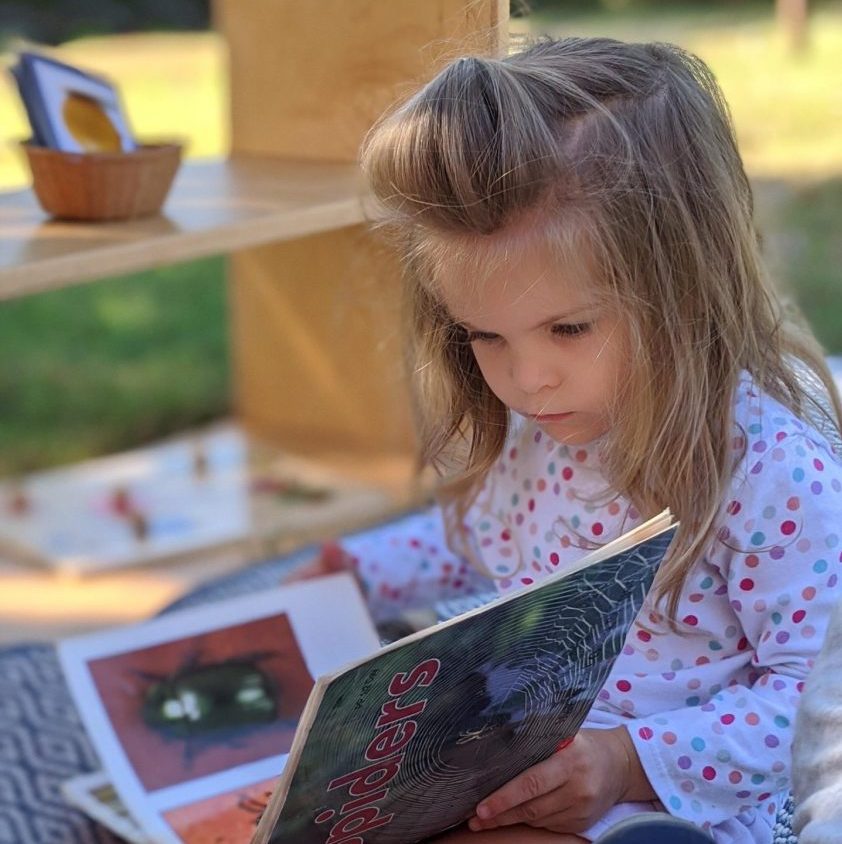
Toddler Outdoor Reading, The Montessori Academy of Arlington, Private School Arlington TX

themontessoriacademy

Preparing children for life, not just the next test.

Purposeful Work, Meaningful Learning 🌱 There's so Purposeful Work, Meaningful Learning 🌱

There's so much learning happening in this simple moment.

As part of snack preparation, this Toddler student is carefully slicing a banana with a child-sized safety chopper. Food preparation activities help develop hand-eye coordination, concentration, fine motor control, and independence. Each deliberate cut requires focus, precision, and patience.

In Montessori classrooms, practical life activities like this build confidence through meaningful work. Children aren't practicing skills "just because" they're told to. They are contributing to a real task with a real purpose. By repeating the motion again and again, this student is refining movements, strengthening concentration, and experiencing the satisfaction of preparing a snack independently.

Moments like these remind us that some of the most important learning happens through everyday activities.

#HandsOnLearning #Concentration #FineMotorSkills #PurposefulActivity #PreparationForLife #PrivateSchool #TheMontessoriAcademyOfArlington
Ever wonder how one Montessori teacher can effecti Ever wonder how one Montessori teacher can effectively teach students from three different grade levels in the same classroom?

The answer is visible in moments like this. Instead of standing at the front of the room delivering the same lesson to every child, Montessori teachers provide individual and small-group lessons tailored to each student's readiness and needs. 

Once a lesson is given, students put their learning into action through purposeful, hands-on work that allows them to practice concepts independently and build deeper understanding.

In this moment, two Lower Elementary students are using the Stamp Game, a Montessori math material that helps children develop a concrete understanding of place value and arithmetic. While they work, they're actively applying what they've learned, strengthening their problem-solving skills, and gaining confidence in their abilities.

It's a beautiful example of what Montessori education does best: meeting each child where they are and helping them grow from there. ✨

#HandsOnLearning #PurposefulActivity #ProblemSolvingSkills #Confidence #Independence #PreparationForLife #TheMontessoriAcademyOfArlington
🧠 🌱 One thousand. Two thousand. Three thousand. I 🧠 🌱 One thousand. Two thousand. Three thousand.

In Montessori, children don't simply learn about place value. They build it.

Using beautiful, hands-on materials, children can see, touch, count, and compare quantities, making complex mathematical concepts meaningful and understandable. They can feel the weight of the thousand cubes in their hands, experience the difference between quantities, and physically construct numbers in a way that brings math to life.

Completing a large-scale work like this also requires tremendous concentration, persistence, and attention to detail. As children carefully carry, organize, count, and arrange the materials, they are developing far more than mathematical understanding. They are building focus, independence, and confidence in their own abilities.

When learning is concrete, understanding follows. 💚

#HandsOnLearning #MontessoriMath #DecimalSystem #Concentration #Independence #PrivateSchool #Nontraditional #TheMontessoriAcademyOfArlington
🎃 🔨 Joyful work is at the heart of Montessori. In 🎃 🔨 Joyful work is at the heart of Montessori.

In our Toddler courtyard, children are free to choose from a variety of carefully prepared activities designed to support their development and spark their curiosity. One current favorite is hammering golf tees into a pumpkin!

What may look like a simple seasonal activity is actually helping children strengthen hand-eye coordination, refine the fine motor skills needed for future writing, develop concentration, and build confidence through independent work.

The smiles say it all. When children are engaged in meaningful, hands-on experiences, learning becomes something they love.

🍁 Learning through joy. Growing through discovery.

#HandsOnLearning #HandEyeCoordination #FineMotorSkills #Concentration #PurposefulActivity #Nontraditional #PrivateSchool #TheMontessoriAcademyOfArlington
👀🧩 A keen eye for detail starts with experiences l 👀🧩 A keen eye for detail starts with experiences like these.

The Montessori Knobbed and Knobless Cylinders help children refine their visual discrimination by identifying and matching subtle variations in height and diameter.

As children compare, sort, and align corresponding cylinders, they strengthen concentration, attention to detail, logical thinking, and early mathematical reasoning. The work also develops the pincer grip and hand control needed for writing, while giving children repeated opportunities to analyze, problem-solve, and self-correct independently.

Through hands-on exploration, children build an intuitive understanding of dimension, classification, and spatial relationships, creating a strong foundation for future learning in mathematics and geometry.

#HandsOnLearning #SensorialMaterials #ProblemSolvingSkills #LearningThroughDiscovery #Nontraditional #TheMontessoriAcademyOfArlington
🧠 ✍️ What makes a piece of writing clear and effec 🧠 ✍️ What makes a piece of writing clear and effective?

In our Upper Elementary classroom, students are investigating that question firsthand. Working collaboratively, they are analyzing a completed piece of writing and reconstructing the outline behind it, discovering how ideas are organized, supported, and connected.

This hands-on lesson helps students develop critical thinking, reading comprehension, communication, and writing skills while making the structure of good writing visible. Rather than memorizing a formula, students uncover the patterns that help writers communicate clearly and effectively.

Through collaborative discovery and purposeful discussion, Montessori students build the understanding and confidence needed to become thoughtful, capable writers.

#Collaboration #CriticalThinkingSkills #ReadingComprehension #WritingSkills #Nontraditional #TheMontessoriAcademyOfArlington
😊 The smile says it all! What happens when a tod 😊 The smile says it all! 

What happens when a toddler is given a magnet and the freedom to explore? She becomes a scientist. 🔬🧲 

As she experiments with different objects, she's developing observation skills, critical thinking, concentration, and an understanding of cause and effect. Her delighted reactions remind us that some of the most meaningful learning happens when children discover answers for themselves.

#HandsOnLearning #Science #Concentration #CriticalThinkingSkills #PrivateEducation #Nontraditional #TheMontessoriAcademyOfArlington
Fresh materials, fresh discoveries! 🍂🎃 In our Tod Fresh materials, fresh discoveries! 🍂🎃

In our Toddler Montessori courtyard, children are exploring a seasonal sorting activity using pumpkins and gourds. What may look like simple play is actually rich learning. As toddlers compare sizes, shapes, colors, and textures, they are strengthening concentration, developing fine motor skills, building vocabulary, and laying the foundation for early math concepts such as classification and sorting.

Our teachers thoughtfully rotate materials throughout the year to reflect the changing seasons and children's evolving interests. This keeps the environment engaging, encourages new discoveries, and provides endless opportunities for hands-on learning through nature.

In Montessori, the environment is a teacher too, and every season brings something new to explore! 🌿🧡

#HandsOnLearning #Concentration #FineMotorSkills #OutdoorLearning #PrivateEducation #Nontraditional #TheMontessoriAcademyOfArlington
The hidden complexity behind a toddler pouring wat The hidden complexity behind a toddler pouring water. 💧🌸

When adults observe a child pouring water through a funnel, it’s easy to focus solely on fine motor skill. But in a Montessori environment, the pour is only one link in a rich developmental chain.

Before this student poured a drop, they engaged in a high-level sequence of executive functioning:

╼Internal Order & Sequence: Remembering the exact steps—carry the tray, take the pitcher to the sink, fill it, walk back, position the funnel.

╼Gross Motor & Balance: Carrying a pitcher of water across a room without spilling requires immense bodily control and focus.

╼Fine Motor Precision: Aiming the spout into a funnel and stopping before the glass overflows.

╼Grace & Courtesy: Placing the flower into the water to decorate the room for everyone to enjoy.

That proud eye contact with the camera at the end isn't seeking external validation—it's the natural reward of intrinsic achievement. They set out to complete a real, meaningful cycle of work entirely on their own, and they succeeded.

#HandsOnLearning #OrderAndSequence #Concentration #IntrinsicMotivation #PrivateEducation #Nontraditional #TheMontessoriAcademyOfArlington
On the surface, it’s just making applesauce. Below On the surface, it’s just making applesauce. Below the surface? It’s foundational brain development. 🧠🍎

Swipe through to see our young chefs in action, and read why this work is so much more than cooking:

─Fine Motor Control & Hand Strength: Turning the handle of the apple peeler and carefully using a chopper build the small muscle groups in the hand, preparing the grip needed for handwriting. 

─Executive Functioning & Sequence: Following a multi-step recipe (peeling → chopping → measuring → cooking) exercises working memory, planning, and focus. 

─Bilateral Coordination: Holding an apple steady with one hand while cranking or cutting with the other requires both sides of the brain to communicate seamlessly. 

─Sensory Processing & Math: Measuring cinnamon, feeling textures, smelling spices, and observing physical changes (from crisp fruit to smooth sauce) ground abstract math and science concepts in concrete reality. 

─Independence & Community: Taking responsibility for preparing food to share with peers builds true self-reliance and a spirit of contribution. 

Practical Life work reminds us that the process is always where the true magic happens, not just the finished product. 🍏✨ 
#HandsOnLearning #FineMotorSkills #OrderAndSequencing #Independence #PrivateEducation #Nontraditional #TheMontessoriAcademyOfArlington
From 3D objects to abstract symbols: watch how ear From 3D objects to abstract symbols: watch how early math progression happens in a Lower Elementary Montessori classroom! 🧮✨

Golden Bead Addition: Purely Concrete

The Experience: Children physically hold single unit beads, 10-bars, 100-squares, and massive 1000-cubes. A thousand actually feels a thousand times heavier and larger than a single unit!

The Benefit: Builds an intuitive, tactile understanding of quantity, place value, and the true physical scale of large numbers before standard algorithms are introduced.

Stamp Game Subtraction: Moving Toward Abstraction

The Experience: The heavy, dimensional bead material is replaced by small, uniform wooden tiles ("stamps") color-coded by place value (green for units/thousands, blue for tens, red for hundreds).

The Benefit: A single green tile now represents 1,000 without weighing like a thousand beads. This bridges the gap between concrete physical objects and pencil-and-paper math, building strong problem-solving skills and mental agility.

By allowing children to touch, move, and visualize mathematical concepts first, Montessori turns complex four-digit operations into an engaging puzzle rather than a memorization chore! 💡✨

#ConcreteToAbstract #HandsOnLearning #ProblemSolvingSkills #MentalAgility #IntrinsicMotivation #PrivateEducation #Nontraditional #TheMontessoriAcademyOfArlington
Why do we call play "work" in a Montessori classro Why do we call play "work" in a Montessori classroom? 💡

In our Infant program, materials aren't just toys—they are precise tools designed to aid a child's development. When infants work with this wooden rocking ring stacker, they are actively engaging in:

--Hand-Eye & Spatial Coordination: Judging distances and aligning the ring's center with the wooden peg.

--Order & Sequence: Experimenting with how items fit together, fostering early mathematical reasoning.

--Deep Concentration: Building an uninterrupted focus span, which is the cornerstone of all future learning.

Montessori environments meet infants right where they are, offering purposeful activities that satisfy their natural drive for independence and mastery. 🌸

#HandEyeCoordination #OrderAndSequence #DeepConcentration #HandsOnLearning #PrivateEducation #Nontraditional #TheMontessoriAcademyOfArlington
Building big math minds, one bead at a time! 🌟 Us Building big math minds, one bead at a time! 🌟

Using the Montessori Short Bead Stair alongside small, numbered tiles makes abstract mathematical concepts tangible for young learners. Here is why this hands-on work is so impactful for early development:

--Concrete Quantity Recognition: Each colored bead bar visually and physically represents a specific quantity, allowing the child to feel and see the difference between numbers 1 through 10 rather than just memorizing symbols.

--Defined Workspace: Working on a small mat teaches organization, boundary awareness, and visual order, helping the child sustain deep focus.

--Multi-Sensory Reinforcement: Matching the physical bead bar to the written wooden tile, and then recording it on paper with colored pencils, bridges tactile touch, color association, and fine motor control.

--Pre-Writing & Control of Movement: Coloring the corresponding shapes on paper refines pencil grip, strengthens hand muscles, and builds the spatial control needed for writing.

--Self-Directed Mastery: The color-coded design of the bead stair allows the child to spot their own mistakes, fostering independence, problem-solving, and confidence.

Watch how small, purposeful movements turn foundational math into pure joy! ✨

#BeadStair #HandsOnLearning #FineMotorSkills #MultiSensory #IntrinsicMotivation #PrivateEducation #Nontraditional #TheMontessoriAcademyOfArlington
Collaborative discovery and hands-on creation in o Collaborative discovery and hands-on creation in our Upper Elementary classroom! 🔬✨

Learning thrives through teamwork and tangible experiences. Our students paired up to explore scientific tools using two-part classification cards—working together to match detailed picture cards of apparatuses like beakers, droppers, and ring stands with their correct definitions.

Inspired by their shared research, one student took the concept off the card and into three dimensions, engineering a model of a beaker on a stand over a flame using cardboard and repurposed materials from around the room.

In a Montessori environment, peer collaboration builds deep understanding, giving students the confidence to bring abstract ideas to life by hand! 🛠️🧪

#Collaboration #HandsOnLearning #STEMEducation #ClassroomCommunity #MontessoriScience #PrivateEducation #Nontraditional #TheMontessoriAcademyOfArlington
Capturing the Joy of Language in Lower Elementary Capturing the Joy of Language in Lower Elementary ✨✏️

Watching a child discover how language works from the inside out is pure magic. Today, this student is diving into the world of conjunctions using the Montessori grammar cards.

By physically pairing phrase cards ("a spotted calf" + "the grazing cow") with the pink conjunction bar and placement symbols, abstract grammar becomes a concrete, hands-on experience.

Here is why this is so powerful for young learners:

--Movement & Order: Working on the floor with a rug gives children the space they need to stretch out, organize their materials, and build strong habits of order and concentration.

--Visual & Tactile Learning: Using distinct geometric symbols (black noun triangles, blue adjective/article triangles, and the pink conjunction bar) translates complex sentence structures into clear visual patterns.

--Connecting Reading to Writing: Transcribing the completed phrases reinforces spelling, handwriting, and sentence construction, bridging the gap between decoding text and creating it.

When grammar is taught through sensory exploration and self-directed practice, learning to write isn't a chore, it’s an invitation to construct meaning.

#MovementAndOrder #TactileLearning #DecodingAndCreating #GrammarInAction #HandsOnLearning #IntrinsicMotivation #Nontraditional #TheMontessoriAcademyOfArlington
Follow on Instagram

Schedule a tour today!

Schedule Now
  • Instagram
  • facebook
  • YouTube
TMA Logo TMA Logo, The Montessori Academy of Arlington, Private School Arlington TX
The Montessori Academy of Arlington tagline: Preparing Children for Life, Not Just the Next Test.

3428 W. Arkansas Lane

Arlington, TX 76016

817.274.1548
info@tmaonline.org

Privacy Policy & SMS Terms of Service

Schedule a Tour Contact Us
© 2026 The Montessori Academy of Arlington
Use arrow keys to move between tabs
FAQs
Call Us
Contact Us
Welcome to our FAQs
Type your question below.
Welcome!
Get in Touch
Welcome!
Do you have questions not in our FAQs?
Search Results
  1. Home
  2. Search Results
  3. Article
FAQs
Questions? We have answers! Call us during regular business hours (8:00 am - 5:00 pm).
Phone
Family Guide
Do you have space for my child?

Our current openings are as follows:

  • Infant: January 2028
  • Toddler: Limited mid-year availability
  • Early Childhood: Wait Pool for 2026-27
  • Lower Elementary: Wait Pool for 2026-27
  • Upper Elementary: Limited availability


Schedule a visit!

What are your hours?

We are open between 7:00 am and 6:00 pm, Monday through Friday. The school day is from 8:30 am to 3:30 pm, with Before Care from 7:00-8:30 am and Extended Day from 3:30-4:30 pm or Extended Day Plus from 3:30-6:00 pm.

During the summer, our Extended Day hours are slightly reduced - Before Care begins at 7:30 am, and Extended Day Plus ends at 5:30 pm.

How much does it cost?

The cost varies by program level. Our Tuition and Fee Schedule is available online.

Do you accept TEFA funds (vouchers)?

We will accept Texas Education Freedom Account (TEFA) funds for the 2026-27 school year. Please visit the official TEFA website to apply for the program. A helpful Family Checklist provides information about the documents needed to apply and other details to guide families through the process.

Can I pay monthly?

Yes. Tuition can be paid in-full or on a monthly basis. If parents choose to pay on a monthly basis, parents are required to purchase  tuition insurance, which is 2.6% of the annual tuition, paid one time each year with each new contract, and is due with your first tuition payment in May.

Do I have to sign a contract?

Yes. Our enrollment contracts begin in August and end in May, with an option to enroll in five, 2-week summer sessions. If you are admitted after the beginning of a school year, your tuition is pro-rated based on when you enroll.

Do you offer 2- or 3-day options?

Children thrive with consistency! That's why we only offer programs 5-days per week. Consistent routines empower children to feel confident and in control of their daily experiences.

What are your classroom ratios?

Our ratios vary by program:

  • Infant – 1:4 (2 teachers for 8 students)
  • Toddler – 1:8 (2 teachers for 16 students)
  • Early Childhood – 1:12 (2 teachers to 24 students)
  • Elementary – 1:18 (1 teacher for up to 18 students)

While these are the minimum ratios, we have an additional teacher available for each of the Infant, Toddler, and Early Childhood classrooms throughout the day. Elementary students also participate in Enrichment classes with Enrichment Specialist teachers.

Do you require immunizations?

To protect the health of all children and to satisfy state regulations, current medical information for each child is required prior to enrollment. These records, which must meet  state immunization and  hearing and vision screening requirements, need to be updated when new screenings or immunizations are given. An annual physical is required for children in the Infant, Toddler and Early Childhood programs.

The state of Texas allows certain  immunization exemptions and we follow all state guidelines.

How do you communicate with parents?

Several forms of communication are used to meet the needs of our community. These include email, texting, phone calls, written documentation, parent/teacher conferences, a parent portal on our website, a closed Facebook group, and Bloomz, a photo/video sharing app so parents can catch glimpses of the work their children are completing.

We produce a weekly e-newsletter to keep parents informed about school-wide activities and events which is available via email, text, our closed Facebook group, the parent portal, and through Bloomz.

For infants, in additional to daily, in-person communication, teachers record when diapers were changed, meals/snacks were eaten, and naps were taken in the Bloomz app.

Injuries will be promptly treated by a staff member and parents will be notified either by telephone or through a copy of a completed Accident/Incident Report form. Parents will receive a short report which documents how, when, and where and accident or incident occurred.

What is the transition like after graduation?

Students are prepared to succeed wherever they go for middle school. The elementary program provides opportunities for students to practice time management, collaboration, and problem-solving skills on a daily basis, enabling them to adapt to their new schools, whether private, public, or parochial. Want to hear directly from alumni how their transitions were? Check out our Alumni Thoughts page!

Read More
Search for an Answer
Search Guideline

Use up to three keywords instead of using a full sentence for the best search results.

Examples:

product

product warranty

free shipping offer